Sophie Scholl and the White Rose Essence:
Soul Courage United with Highest Ideals
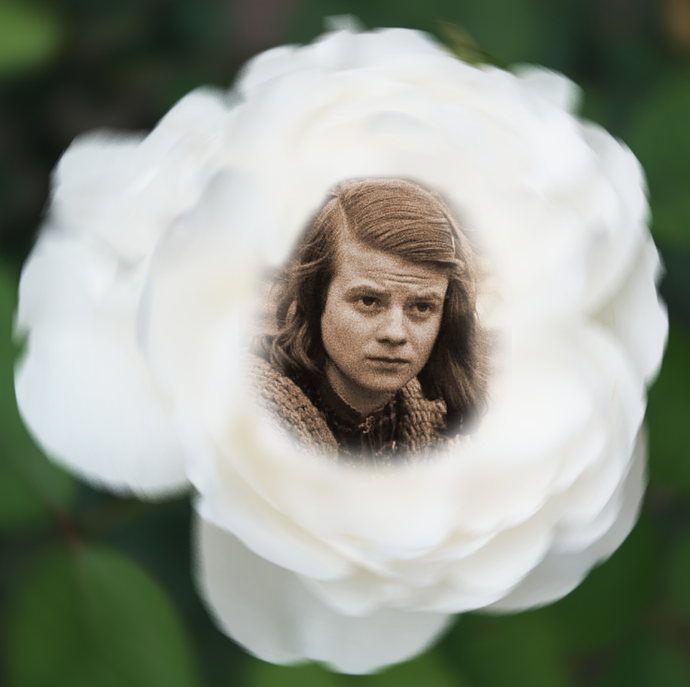
“I did the best that I could do for my nation.
I therefore do not regret my conduct
and will bear the consequences that result from my conduct.”
—Sophie Scholl’s response when sentenced to death for treason on February 22, 1943
Editor’s note: This article is based on an Archetypal Character Study submitted by Moira Krum as one of the requirements for the FES Practitioner Certification. The purpose of the assignment is to compare the qualities of a flower essence with a historical figure or character from fiction. Moira chose the White Rose flower essence, which is still in the early stages of documentation. She showed a further dedication to her research by gathering reports from some of her clients after they agreed to use the White Rose essence and to observe their soul experiences. The following article has been re-formatted and edited for length.
Archetypal Character Study: Sophie Scholl
As a result of my personal experience
taking the White Rose essence and doing so while contemplating and
meditating on Sophie Scholl and the White Rose resistance movement, I
believe Sophie Scholl is a powerful example of the White Rose essence,
which I would describe as “Soul Courage united with Highest Ideals.”
I. Introduction:
A Brief History of Germany Under the National Socialist (Nazi) Party:
What the White Rose Resistance Challenged
In 1933, Adolf Hitler came to power in Germany. Having been defeated in World War I and forced to pay millions of dollars in reparations to the Allied victors, many Germans were disheartened and financially struggling. Hitler promised to make Germany the proud, strong country it once was. Instead, he dissolved the Reichstag (parliament) and declared himself Führer, or supreme head of the government. Gradually, he increased Germany's military strength and began his quest to invade and take over many countries in Europe. Hitler and his regime committed atrocities against many people in Germany and in the countries they invaded. This included killing dissidents, people who were physically or mentally disabled, Slavs, Gypsies, and Jews.
During these years, many Germans did not actively resist the dictatorship under which they lived. Some agreed with Hitler’s plan to restore Germany to the great country it once was. Others benefited from Hitler’s policies. Still others were afraid to speak out in fear of bringing harm to themselves or their loved ones. One might understand why many did not have the courage to speak or act out when the consequence for one’s actions may have been losing their lives.
Some did speak and act out. Many formed resistance groups and worked surreptitiously to bring the truth of Hitler and the Nazis to the German people and to people around the world and to encourage them to resist the Nazis’ evil practices and plans.
One such group of brave men and woman were members of the resistance movement called the White Rose (Weiße Rose). One courageous young woman in this group was Sophie Scholl.
II. Sophie Scholl’s Childhood and Teenage Years
Sophie was born in 1921 in Forchtenberg, Germany. She had an older brother Hans, older sisters Elizabeth and Inge, and a younger brother Werner. Her parents were Robert and Magdalene Scholl. Her father was elected the mayor of their town, but when he failed to win re-election, the family moved first to Ludwigsburg and then to Ulm on the Danube River.
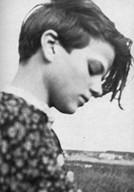
Sophie was a good student. She loved to play music,
dance, create art, and to swim. She had a love of the written word: she kept a
diary, wrote stories, and loved to discuss literature with friends.
At the age of twelve, like most girls her age, Sophie joined the Hitler Youth and League of German Girls. These groups were designed to indoctrinate German youth in Nazi ideology, yet they were centered on enjoyable activities, such as hiking and camping expeditions. Sophie’s father disagreed with the National Socialist youth groups and hoped his views would be taken up by his children. During World War I, he was a pacifist and refused to carry a gun.
It is not surprising that Sophie had deep connections to trees and flowers.
She was described by her friend George
Wittenstein
as, “on one hand very serious and yet very fun-loving. It was more than humor. Sophie enjoyed life to the fullest, and simple nature
—a bunch of grass or blossoms on the
tree, or flowers in the field—could completely change her.
”
In a journal she kept at that time, Sophie wrote, “I can never look at a limpid stream without at least dangling my feet in it; in the same way, I cannot walk past a meadow in May . . . I lie in the grass, quite still, my arms spread, my knees raised and am happy. Through the blossoming branches of an apple tree, I see the blue sky . . . When I turn my head, it touches the rough trunk . . . I press my face to the tree’s dusky, warm bark and think, ‘My homeland,’ and I am inexpressibly grateful.”
Sophie was not very tall, and she was attractive in appearance and free-spirited. Sophie’s brother Hans was three years older than her. He was described by Mueller, a friend, as being “a complicated person, very special, different from other guys. He was very highly educated. . .He had no fear. He had no sense of danger.” Eventually, Hans became disillusioned with the Hitler youth groups and turned to groups that met in secret, such as the d.j.1.11 (Deutsche Jungenschaft or “German Youth.”)
Sophie also became disillusioned when her Jewish friends were not allowed to join the Hitler group for girls.
In 1937, four of the five Scholl children were arrested by the Gestapo, or secret police, due to Hans’s activity in the d.j.1.11 organization. Sophie was quickly released; Inge and Werner were held for a week while Hans was imprisoned for five weeks and then released. Their arrests were a turning point for the Scholl siblings who began to see the way the Nazis were trying to control all aspects of their lives.
Hans began to study medicine and was sent to France as a medic. When she was sixteen, Sophie became friends with a German soldier named Fritz Hartnagel. He recalled Sophie’s firm insistence that one could be either “for Hitler or against Hitler. If you were against Hitler, you had to see to it that he lost the war.” She was firm and vocal about her antiwar and anti-Hitler views.
III. Sophie and the White Rose Resistance
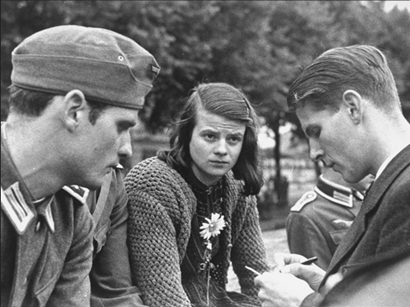
Hans and Sophie Scholl, Christoph Probst
On May 9, 1942, Sophie’s twenty-first birthday, she
went to Munich to begin her college studies in biology and philosophy.
She celebrated her birthday with Hans and some of his new friends, all
of whom were in their mid to late twenties: Christoph Probst, Alexander
Schmorell
, Willi Graf, and George
Wittenstein.
All of them opposed Hitler and the Nazi regime. This group became close friends, often taking walks, attending concerts, and talking about literature, philosophy, and religion.
Another female member of the group was Traute Lafrenz
(Page). She and others in the group were inspired by a remarkable high
school teacher, Erna Stahl, whose teaching was in turn inspired by Rudolf
Steiner’s pedagogy. Having been banned from teaching, Stahl began
secretly educating students in her home. Traute Lafrenz spoke of waking up to the world when Erna became her teacher (Poer, “The Spiritual Light of the White Rose”).
Stahl wrote of her time as a teacher of these courageous students,
“I became convinced that there was a destructive, demonic denial of all human spiritual worth, especially in Germany, which could not be undone. I made a solemn pledge that in the circles where I carried out my work, each and every minute, and with all the means I had at my disposal, I would work to create some kind of inner counterbalance to these destructive forces in my students.”
The students formed the White Rose movement in Munich in June of 1942. Why did the group choose the name White Rose? The choice of the name is still obscure, although it was obviously intended to represent purity and innocence in the face of evil: it is a poetic or artistic symbol rather than a political one. Later, under Gestapo interrogation, Hans would say that the name was taken from a novel he had read, written by B. Traven and entitled The White Rose ( Dunbach and Newborn).
[Editor’s note: Die
Weiße
Rose, published in Germany in 1929, is a novel about a Mexican hacienda called "The “White Rose.” The ranch is farmed by indigenous people, working in harmony with natural principles until a United States oil company murders the owner and unlawfully seizes the land.]
The initiative had grown out of months of discussions and a growing sense of trust among a small circle of friends, all of whom were repelled by what was happening in Germany. Their intention was to spread the word that there was German opposition to Hitler. They wanted to encourage other Germans to question the dictatorship. They chose to use a nonviolent form of resistance: creating and distributing leaflets. Hans and
Schmorell
prepared the first leaflet called “Leaflets of the White Rose.” These documents criticized the Germans who acquiesced and did not oppose Hitler’s regime, beginning with this declaration:
Nothing is so unworthy of a civilized people as allowing themselves to be governed—
without resistance—by an irresponsible and base clique. Is not every honest German today ashamed of his government? And who among us can guess the dimensions of the shame that will engulf us and our children, when the veil falls from our eyes one day and the most gruesome and immeasurable crimes come to light?
When Sophie first saw the leaflet, she was not sure who had created it. Her brother did not at first want to allow women to take part in their risky activities. Eventually, however, Sophie helped prepare and distribute the leaflets and managed the group’s finances. Franz Mueller stated, “Sophie Scholl, she was the heart—Hans and Alex were the thinking behind the White Rose” (Axelrod 62-63).
The White Rose group continued to prepare and distribute leaflets bearing the title “Leaflets of the White Rose.” They were printed on hand-operated mimeograph machines and mailed to some people sympathetic to their cause. The second leaflet referred to the murder of “300,000 Jews” and intellectuals. They were one of the first groups to announce this reality to the public.
Subsequent leaflets encouraged Germans to sabotage the German war industry and described the war as a manifestation of evil. All of the leaflets condemned the Nazi regime and listed their crimes against humanity.
Some people turned in these leaflets to the Gestapo, who began to investigate their origin, eventually determining that they were produced in Munich. When traveling by train, Sophie and the other girls in the group transported leaflets in their luggage.
Hans and others were sent for a tour of duty in Russia. Sophie then left Munich to serve her duty in an armaments factory in Ulm. Here she worked alongside Soviet slave laborers. Sophie learned that the SS* had been killing mentally disabled children in gas chambers. Her father was sent to prison for four months for making critical remarks about Hitler. The White Rose group continued to see the necessity of resisting this horrific regime.
*Editor's note: The SS (Schutzstaffel, or Protection Squads), were Hitler’s paramilitary force, who administered the death camps and terrorized opponents.
None of the White Rose members told their family members of their activities. They knew how dangerous their resistance activities were and what a high price they or their family members would possibly pay.
In January and February of 1943, the last two leaflets of the White Rose were printed. Working day and night, they printed more than 8,000 copies. To avoid suspicion, Sophie and
Traute
Lafrenz
bought paper and stamps in various places around Munich.
The fifth leaflet exhorted the Germans to consider a “new Europe”:
Germans! Do you and your children want to suffer the same fate as the Jews? Freedom of speech, freedom of religion, protection of individuals from the arbitrary will of a violent, criminal state, this will be the foundation for a new Europe!
The group distributed the leaflets in many places throughout Germany and mailed them from a variety of different locations. Sophie told her sister Elizabeth, “The night is the friend of the free,” as many of their distribution activities, including leaving leaflets in public places and on parked cars, was done at night.
After the German military was defeated at Stalingrad, Hans, Alex, and Willi covered buildings in Munich with graffiti bearing slogans such as “Hitler Mass Murderer!” and “Freedom!”
The Gestapo had been investigating who was involved in these resistance activities. They offered 1,000 reichsmarks for help in arresting members of the resistance.
IV. Sophie’s Arrest and End-of-Life
The first arrest of a White Rose member came on February 14 or 15, 1943. On February 18, before the Scholls were properly warned of these arrests, Hans and Sophie carried a suitcase of leaflets to the university in Munich. They placed piles of leaflets in the halls while students were in class.
Realizing they had some left in the suitcase, they returned to the hall. At this time, Sophie threw leaflets out onto the balcony below. She later said she was not sure why she did it. The custodian saw Sophie do this. The doors were locked, Hans and Sophie were questioned, and the leaflets were shown to fit into the suitcases they were carrying. Hans and Sophie were arrested. When their rooms were searched, police confiscated hundreds of unused stamps.
Hans had a hand written draft of a
leaflet by Christoph Probst in his pocket. The Gestapo took it and
identified the writing as Christoph’s based on papers found in Hans’s
room. The next day, Christoph was arrested; his wife had just given
birth to their third child.
Hans and Sophie were interrogated separately for seventeen hours. After the evidence was found in their apartment, they were forced to admit their involvement in the resistance. They continued to be questioned for four days, always insisting they were the only two responsible for the White Rose movement.
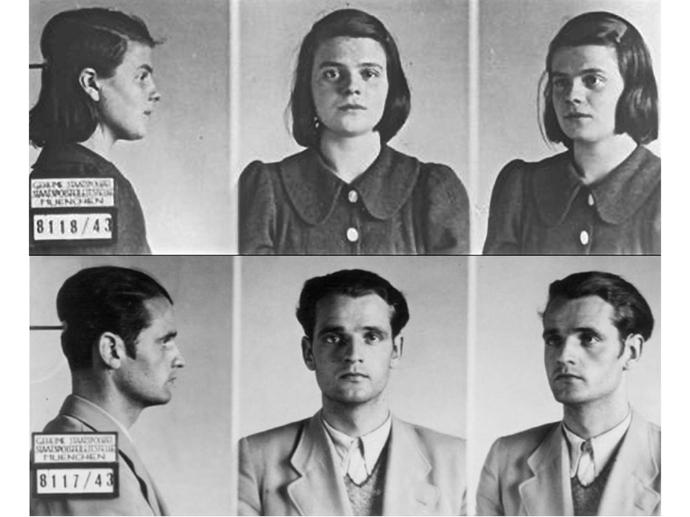
Gestapo mug shots of Sophie and Hans Scholl.
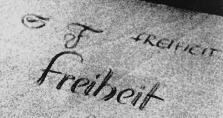
Sophie wrote “Freiheit ” (“ Freedom ”) on the back of her indictment the day before her execution.
Hans and Sophie’s trial was set for the following
Monday, February 22. A notoriously harsh judge was sent from Berlin for
the trial. Sophie’s parents sneaked into the court. Robert spoke out in
support of his children, and he and Magdalene were thrown out of the
courtroom. Hans and Sophie hoped they could free Christoph by taking all
the blame themselves; they were unsuccessful in this attempt. All three
were found guilty of high treason.
Hans and Sophie were able to see their
parents in the prison. Robert told Hans he would become famous for what
he had done. Hans thanked his parents for giving him life and for
loving and supporting him. “I have no hatred for anyone anymore. I have
put all that behind me,” he said.
Sophie’s mother gave her some cakes. Sophie smiled and said she hadn’t had lunch. Magdalene said, “I’ll never see you come through the door again.” Sophie responded, “Oh, what do those few short years matter, Mother?” She paused then added, “We took the blame, for everything. That is bound to have its effect in time to come.”
The prison chaplain visited them and
read passages from the Gospel of St. John: “Greater love hath no man
than this, that a man lay down his life for his friends.”
At 5:00 p.m. on February 22, 1943, Sophie was led to the execution chamber where she died by guillotine. She was twenty-one years old. Hans followed her; he was twenty-four. Christoph followed. Hans’s last words before dying were “Long live freedom!”
On February 24, the first three martyrs of the White Rose were buried in
Perlach
Cemetery in South Munich.
After their executions, someone painted graffiti in Munich reading’ “Their spirit lives.” The final leaflet was again printed and distributed and an extra line added: “Despite everything, their spirit lives on.”
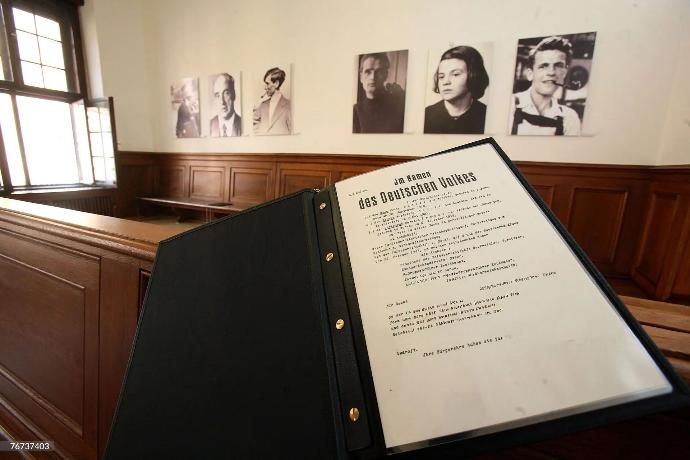
White Rose Memorial at the Munich court where the White Rose Nazi trial took place in 1943.
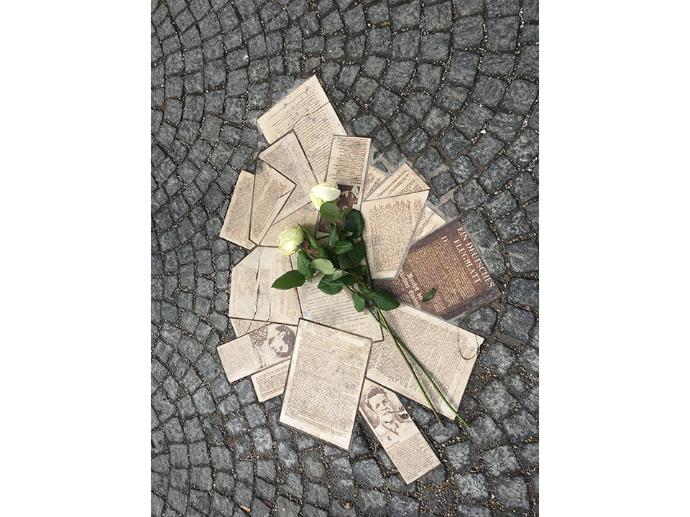
The memorial for the White Rose depicts the group’s flyers. It is in front of the main building of the Ludwig Maximilians University in Munich where Sophie and her White Rose colleagues attended and where they were arrested.
V. Conclusion
As I wrote at the beginning of this study:
I believe Sophie Scholl is a powerful example of the White Rose essence, which I would describe as “Soul Courage combined with Highest Ideals.”
Nancy Jewel
Poer
writes of the White Rose resistance group:
“It is my view that the White Rose individuals are a vanguard part of a powerful spiritual stream in human evolution
. . .
Sophie Scholl’s words and the deeds of the White Rose are meant for us in our time. They shine forth with courage and moral consciousness for us living on Earth at this incredibly decisive time!”
Works Cited
Axelrod, Toby. Hans and Sophie Scholl: German Resisters of the White Rose. New York: The Rosen Publishing Group, Inc., 2001.
Dumbach, Annette and Jud Newborn. Sophie Scholl and the White Rose. London: Oneworld Publications, 1986.
Freedman, Russell. We Will Not Be Silent: The White Rose Student Resistance Movement that Defied Adolf Hitler. New York: Clarion Books, 2016.
Poer, Nancy Jewel. “Holy Nights Series, The White Rose.” . Accessed August 11, 2024.
Poer , Nancy Jewel. “The Spiritual Light of the White Rose of World War 2, Shining for Humanity.” Accessed August 11, 2024
Reflections on the White Rose Movement and the White Rose Flower Essence
Those of us who have researched the White Rose essence have experienced feeling a deeper connection to others. I see this quality present in the profound connections that developed among the members of the White Rose group. They worked together in a very close way
—risking their lives and entrusting their lives to each other.
What deep trust they had in each other! How they strengthened each other to live out the highest ideals! What courage they gave each other! The White Rose essence supports us in being able to deeply connect with others, out of our heart forces—while engendering courage both in ourselves and in others to act out of the highest ideals.
Based on my own experience and a few recent case studies, I believe the White Rose essence can support us in developing and expressing Soul Courage combined with the Highest Ideals. White Rose is a powerful essence that feels very important and relevant to our time.
Sophie Scholl’s life embodied Soul Courage combined with the Highest Ideals. It is no coincidence that their movement was named the White Rose.
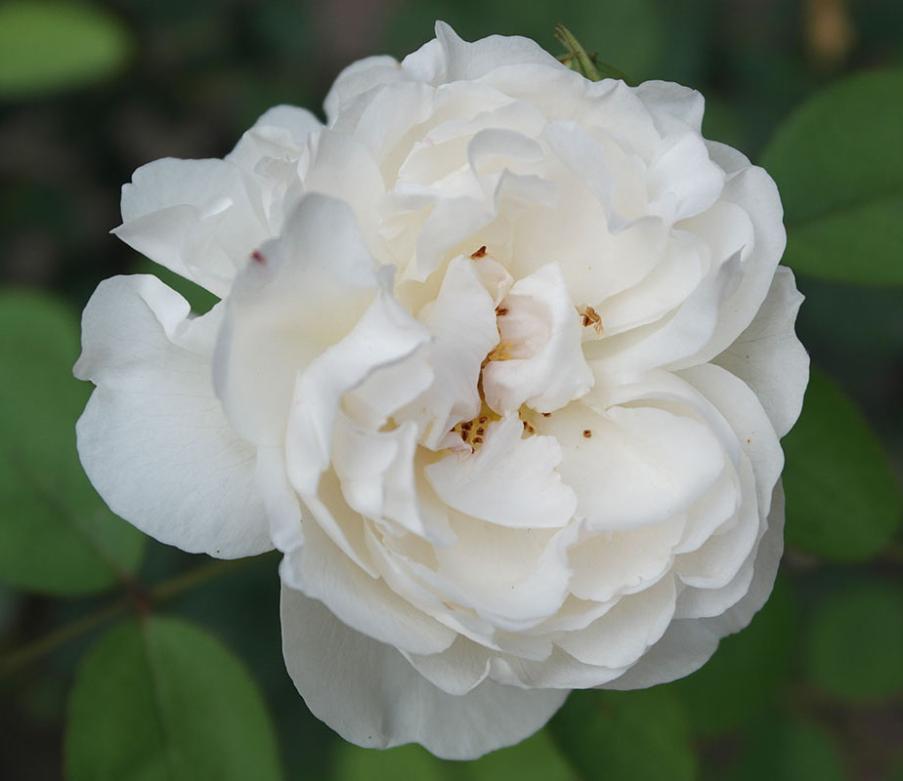
I believe Sophie Scholl is a powerful example of the White Rose essence, which I would describe as “Soul Courage combined with Highest Ideals.”
The Healing Message of the White Rose Flower Essence
White Rose essence emboldens courage, trust, faith, love, and hope and supports a person in contemplating, questioning, even planning one’s actions that will engender these traits.
What does one do to embody the highest ideals, to create imaginations for humanity’s future, to promote and have courage for the truth?
In living out humanity’s highest ideals, we help heal and transform Earth into the planet of love which is its task and mission. Even when we face thorns and are hurt, despairing, despondent, our suffering transforms us and we in turn heal the earth by enduring the hardship and purifying our thoughts, feelings, desires, and actions and fructifying the earth through these human activities and our striving.
The White Rose group sought to awaken Germans to live out of High Ideals, not succumb to lower self: fears, ignorance, hatred, obedience. They offered their lives for the good of humanity—for the highest ideals to be empowered and not snuffed out like a candle flame (as was happening in Nazi Germany). Their light was the conscience of the people.
Wake up! Seek the light! Live with courage, conviction, compassion! The White Rose group wrote the truth even when it cost them their lives. This beacon of light
still
shines today. It is still there in the cosmos and in human hearts of Good Will. For once light is offered, it remains a powerful force that cannot be extinguished. Its effects are lasting, like those of the White Rose resistance.
White Rose challenges us: face the hardships, challenges, and sufferings courageously and know you are supported by Divine Beings who Lovingly Guide You.
These are the gifts of the White Rose: transformation through suffering. Purifying ourselves through striving to do better. Having compassion for others and for ourselves. Striving to embody the Highest Ideals.
This verse by Rudolf Steiner came to me to express the White Rose healing message:
Imbue Thyself with the Power of Imagination
Have Courage for the Truth
Sharpen Thy feeling for Responsibility of Soul
Feedback from My Clients Using the White Rose Flower Essence
One of my clients who was using the White Rose essence wrote in her journal: “An ease and confidence is present and natural now in situations that could have had a more negative effect on me. I feel more resilient and confident in my core and in my responses. I have the courage to bring up a difficult issue, discuss it and then let it go. Inner discernment is more developed and an inner perception of what is true
. . .
There is a
. . .
courage to speak the truth (in a kind way) and stand up for it, or my understanding of it.
“
It took such courage for me to feel in my bones that I had a right to speak my truth to a large audience
. . .
I felt calmer and more purposeful and collected and I was met with warmth and gratitude!”
After not taking the White Rose essences for three days the client reported, “I am experiencing a slump in my inner strength
—in my sense of self confidence. Gone is that feeling of inner certitude.” She resumed the essence and wrote, “It helped IMMEDIATELY. I was able to move from dark and debilitating thoughts into a more positive realm. And stay there. I guess I need to take it daily to strengthen that inner muscle of fortitude and inner certitude.” She said that she felt as if the White Rose essence allowed her to have more sensitized experiences of the other and of the natural world, a deeper connection with herself while staying grounded on the earth.
Another client described how she felt too open, exposed and overwhelmed in her relationships. While taking the White Rose essence she has noticed a deepening quality with her friendships with a feeling of gratitude for her relationships. She started feeling connected to her community and talked about being aware of joy in her relationships and feeling loved. She can now share warmth with others through joy and laughing with them. This client also felt compelled to pray more and also to allow herself to feel grounded on the earth. While life has felt harder with this essence, it has strengthened her Higher Self. She commented, “I can more easily stand in my truth. To decide what I am going to do, what I am meant to do, and do it with inner calm and quiet.”
A third client was taking the White Rose essence last month during a trip to stay with her mother, who has dementia. She found that the essence warmed her heart forces and helped give her equanimity and patience in facing the challenges that her mother’s illness presented. She described her sense that the White Rose allowed her to be present in the hardship of facing her mother’s illness and to meet her mother with courage and love. She also did something on this visit with her mother that she had not done before: she took time for herself to drive to the beach every day and sit and look out at the horizon. She made the analogy that working with the White Rose essence was like a bird flying against the wind to gain greater height. It was not necessarily easy. It challenged her. Yet like the bird, it gave her a “higher perspective.”
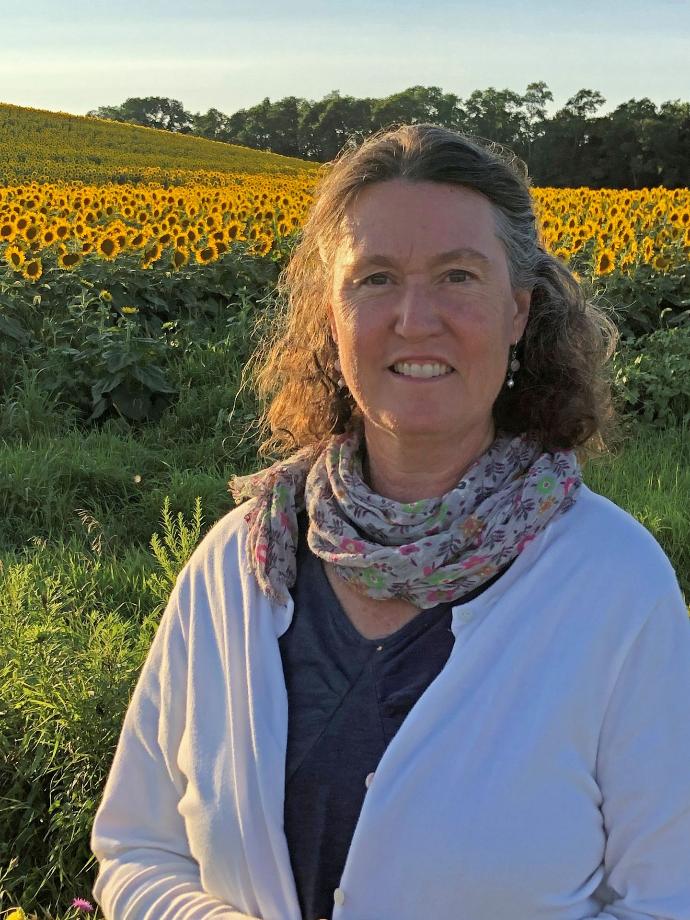
Moira Molloy Krum
is a Flower Essence Practitioner living in Columbia County, New York.
Moira completed the FES Practitioner Training Course with Ruth Toledo Altschuler in 2022, at
Terra Flora
with Patricia Kaminski and Richard Katz in 2023; and through the School for Flower Essence Studies in 2024.
She is also a Waldorf-trained home school tutor.
She loves learning about plants and flower essences, and walking among trees and flowers in nature.
Editor’s Appendix: More information about Sophie Scholl and the White Rose movement:
Sophie Scholl and the White Rose, by Tanja B. Spitzer, The National WWII Museum, New Orleans, Louisiana
The White Rose Project, University of Oxford (UK)
The White Rose Resistance Group, White Rose Foundation, Munich, Germany
Leaflets of the White Rose Resistance Group, with links to English translations
Demonstration of how the leaflets were made (White Rose Foundation / Weiße Rose Stiftung e.V.):

To install this Web App in your iPhone/iPad press  and then Add to Home Screen.
